GW-CMB2026 will be held in Taiwan in 2026, bringing together leading researchers in gravitational-wave (GW) physics, cosmic microwave background (CMB) cosmology, and early-Universe science.
The central objective of GW-CMB2026 is to strengthen the scientific bridge between the gravitational-wave and cosmology communities at a pivotal moment in experimental progress. Ground-based GW observatories such as LIGO, Virgo, and KAGRA continue to refine their sensitivity, while next-generation detectors are under active development. In parallel, precision CMB observations are entering a new era of sensitivity to primordial tensor modes and fundamental physics.
The workshop will focus on the following key themes:
The central objective of GW-CMB2026 is to strengthen the scientific bridge between the gravitational-wave and cosmology communities at a pivotal moment in experimental progress. Ground-based GW observatories such as LIGO, Virgo, and KAGRA continue to refine their sensitivity, while next-generation detectors are under active development. In parallel, precision CMB observations are entering a new era of sensitivity to primordial tensor modes and fundamental physics.
The workshop will focus on the following key themes:
- Current and next-generation gravitational-wave detectors
- Searches for the stochastic gravitational-wave background
- Primordial gravitational waves and early-Universe physics
- Quantum-noise-limited interferometry and advanced calibration
- CMB polarization and tensor constraints
- Joint likelihood frameworks and multi-probe cosmology
- Cross-correlation strategies between GW and CMB datasets
GW-CMB2026 is designed not only as a scientific meeting but also as a strategic forum for future international collaboration. By encouraging direct dialogue between GW experimentalists, cosmologists, and theorists, the conference aims to identify unified analysis approaches and coordinated observational strategies for the coming decade.
Taiwan hosts a dynamic and rapidly growing research community in gravitational-wave and cosmology science. National Central University (NCU), the Academia Sinica Institute of Astronomy and Astrophysics (ASIAA), and the Leung Center for Cosmology and Particle Astrophysics (LeCosPA) form the core foundation of GW–CMB research in Taiwan.
NCU contributes to gravitational-wave instrumentation and detector development, ASIAA plays a leading role in observational cosmology and CMB experiments, and LeCosPA provides theoretical expertise in early-Universe physics and fundamental cosmology.
This foundation is further strengthened by a broad network of universities and research institutes across Taiwan contributing to detector technology, cosmological data analysis, theoretical modeling, and multi-messenger astrophysics.
By hosting GW-CMB2026 in Taiwan, we aim to strengthen international collaboration and position Taiwan as a natural bridge between gravitational-wave experimentation and cosmological exploration.
Taiwan hosts a dynamic and rapidly growing research community in gravitational-wave and cosmology science. National Central University (NCU), the Academia Sinica Institute of Astronomy and Astrophysics (ASIAA), and the Leung Center for Cosmology and Particle Astrophysics (LeCosPA) form the core foundation of GW–CMB research in Taiwan.
NCU contributes to gravitational-wave instrumentation and detector development, ASIAA plays a leading role in observational cosmology and CMB experiments, and LeCosPA provides theoretical expertise in early-Universe physics and fundamental cosmology.
This foundation is further strengthened by a broad network of universities and research institutes across Taiwan contributing to detector technology, cosmological data analysis, theoretical modeling, and multi-messenger astrophysics.
By hosting GW-CMB2026 in Taiwan, we aim to strengthen international collaboration and position Taiwan as a natural bridge between gravitational-wave experimentation and cosmological exploration.
Local organizing committee:
- Yuki Inoue (Chair), National Central University
- Teppei Okumura (Co-Chair), ASIAA
- Masashi Hazumi, National Central University
- Keiichi Umetsu, ASIAA
- Yi-Kuan Chiang, ASIAA
- Chia-Hsien Shen, NTU/LeCosPa
Sponsors
This workshop is sponsored by the Center for High Energy and High Field Physics (CHiP) and is supported by the Physical Society of Taiwan (TPS) and 中華民國重力學會(GSROC).
Code of Conduct
We follow the Code of Conduct of the Physical Society of Taiwan (TPS).
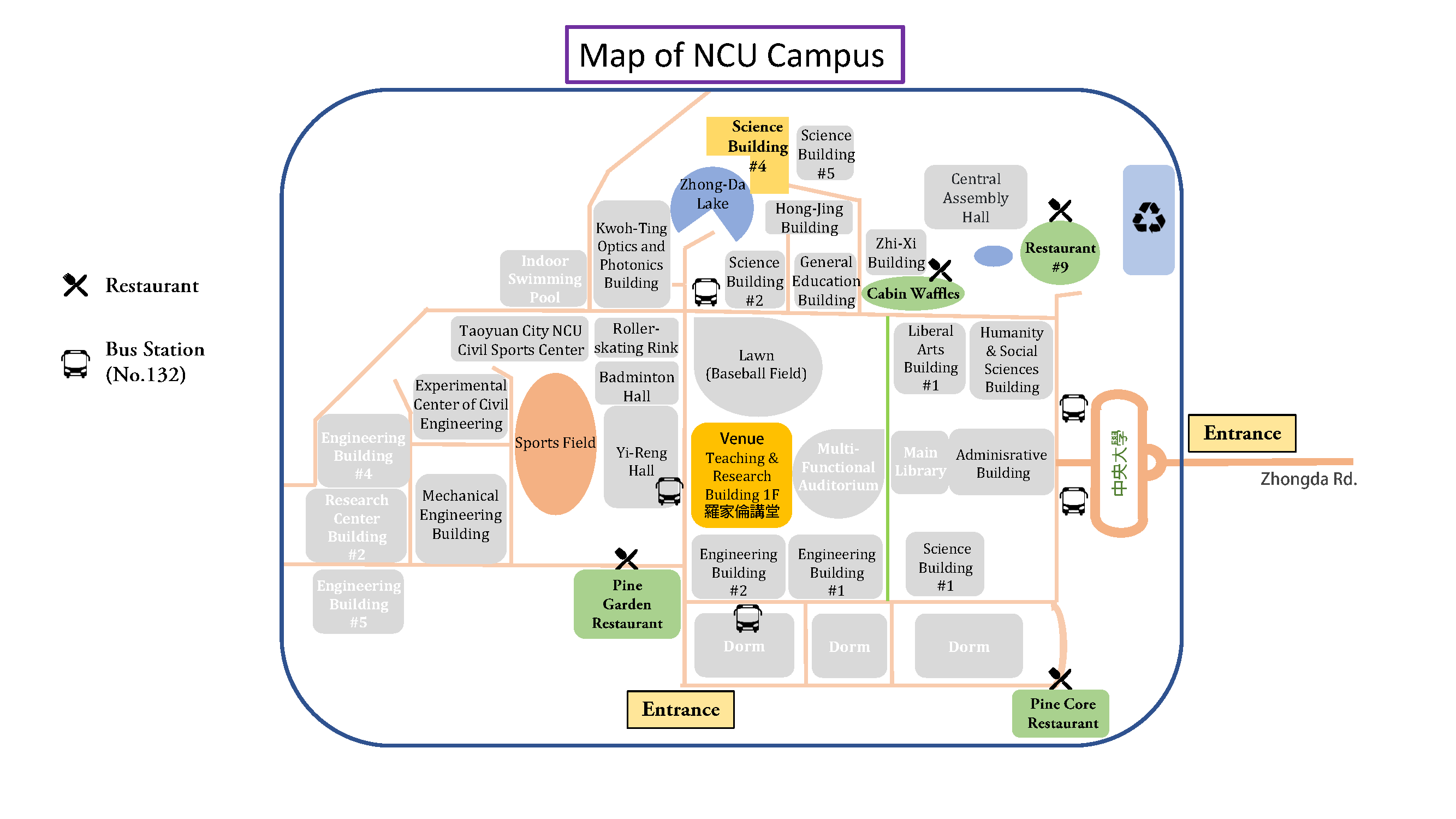
Campus map