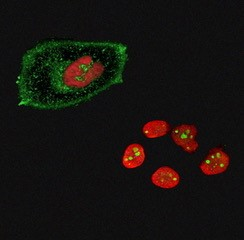
Traditionally, the analysis of biological images has mostly relied on manual operations. In the context of this study, the experimental workflow involves at least the following steps: selecting samples, performing feature extraction, image segmentation to obtain regions of interest (ROI), generating plots and statistics, and conducting image visualization. However, with the rapid advancement...
Microridges are laterally elongated, actin-rich protrusions often found on the apical surface of superficial epithelial cells of zebrafish, where they form evenly spaced, maze-like patterns that continuously remodel through fission and fusion. These conserved structures play key roles in mucus retention and in organizing surface molecules. The studies on microridges are relatively low compared...
Cancer invasion, an indicator of deadly metastasis, is governed by complex tumor microenvironment (TME) interactions, including ECM stiffness. Understanding invasion dynamics is essential for developing effective therapies. In this study, we investigated how ECM stiffness and cellular composition affect cancer invasion using 3D spheroid models. Our results demonstrate that spheroid invasion...
Kinesin motors are essential for intracellular organelle transport. While extensive studies have focused on understanding their collective motion, the reasons for the wide distribution of cargo speeds in cells remain poorly understood. In this study, we examine the relationship between motor numbers, cellular crowding, and cargo velocity during cargo transport in vitro. Our findings indicate...
Substrate geometry affects collective cell migration. Recently, curvotaxis is identified where cells exhibit different preference toward curvature. To further explore the curvotaxis, we fabricated pneumatic-driven microdomes to create the substrate curvature from flat to positively curved surface and observed a novel migratory behavior: epithelial (MDCK) cells exhibit a strong, centripetal...
Introduction
Cells in vivo encounter geometrically complex microenvironments where curvature at the cellular scale can regulate cell morphology and migration [1]. Reduced ECM curvature near solid tumors, for instance, correlates with increased metastatic rate [2]. These observations have motivated the concept of curvotaxis, describing changes in cell movement due to the curvature cues...
Amyloid-β (Aβ) aggregation provides a prototypical example of geometry-regulated self-assembly in biological systems. While amyloid growth is often described in terms of chemical kinetics or tip-growth models, how single-molecule diffusion on fibril surfaces is shaped by physical constraints remains incompletely understood. Here, we use coarse-grained molecular dynamics simulations to...
How bacterial cells maintain energetic balance under complete nutrient deprivation remains largely unknown. In this study, the single-cell energy dynamics of Escherichia coli exposed to extreme starvation, a condition in which no external nutrients are available, was investigated. Using QUEEN-2m, a genetically encoded fluorescence ATP sensor, intracellular ATP levels in individual cells were...
Three-dimensional (3D) spheroid models are a cornerstone of advanced 3D cell culture, offering physiologically relevant microenvironments compared to traditional 2D systems. Controlling spheroid size is essential because drug penetration, hypoxia, and necrosis are strongly size-dependent. Conventional methods often yield variable spheroids, limiting their application potentials to be...
ABSTRACT: Amyloid β (Aβ) aggregation on neuronal membranes is a key event in the pathogenesis of Alzheimer’s disease. Among Aβ isoforms, Aβ42 is particularly pathogenic due to its rapid aggregation and high cytotoxicity. Ganglioside GM1, a glycosphingolipid enriched in neuronal membranes, can form nanoclusters that strongly bind Aβ and induce membrane-associated aggregation. Upon binding to...
Correlation-based analysis has long served as a powerful framework for extracting dynamic and structural information beyond conventional imaging limits. Fluorescence-based super-resolution optical fluctuation imaging (SOFI) leverages temporal intensity fluctuations from the stochastic blinking of fluorophores, achieving resolution enhancement through high-order cumulant analysis. However,...
Extracellular vesicles (EVs) have become recognized as promising natural nanocarriers for targeted drug delivery owing to their biocompatibility and intrinsic cell-specific interactions. This study describes the development of an EV-based nanocarrier system for cancer therapy using ultrasmall gold nanoclusters (1–2 nm) coated with a pH-sensitive PDPH linker connected to curcumin...
DMC1 recombinase is essential for meiotic homologous recombination. Recombinases, such as RAD51, can assemble on DNA to form extended nucleoprotein filaments to function in homology search and strand exchange. Surprisingly, our recent single-molecule measurements show that human DMC1 can form condensed, compact filaments on double-stranded DNA . These condensed filaments differ markedly from...
We start with a model where the bacteria are trying to maximize the long-term access to a chemoattractant and,
using results in gambling thermodynamics, we get a boundary for the drift speed that is linear in the information
rate. This boundary becomes relevant at extremely low chemoattractant concentrations.
Sarcopenia, a prevalent muscle disease characterized by muscle mass and strength reduction, is associated with impaired skeletal muscle regeneration. However, the influence of the biomechanical properties of sarcopenic skeletal muscle on the efficiency of the myogenic program remains unclear. Herein, we established a mouse model of sarcopenia and observed a reduction in stiffness within the...
During development, cells migrate throughout the body along morphogenesis, often encountering mechanical stress that deforms their nuclei, potentially influencing gene expression. In zebrafish embryos, trunk neural crest cells (TNCs) are an embryonic cell type that serves as an ideal model for studying in vivo cell squeezing. They originate from a progenitor region with large interstitial...
This talk will cover two parts of my research. The first part is on my lab's long-term efforts to use spherical pores as 3D cell cultures. Microwell arrays have emerged as three-dimensional substrates for cell culture due to their simplicity of fabrication and promise for high-throughput applications such as 3D cell-based assays for drug screening. To date, most microwells have had cylindrical...
This study investigates the mechanisms underlying the interaction between a single-stranded DNA aptamer and vancomycin. Experimental observations indicate that the aptamer exhibits high selectivity in binding to vancomycin, inducing conformational changes that lead to fluorescence quenching. However, the precise mechanisms remain unclear. To clarify these mechanisms, molecular dynamics (MD)...
Chromatin dynamically alters according to cell cycles and DNA metabolic events. One key factor for the chromatin dynamics is histone chaperones that serve nucleosome assembly and disassembly and play important roles in regulating gene expression as well as for maintaining epigenetic information. It has been reported that nucleosome arrangements are modulated by bromodomain-containing AAA+...
Abstract. Alzheimer’s disease is a neurological disorder characterised by the abnormal accumulation of the proteins including amyloid beta and neurofibrillary tangles, and is closely associated with gradual increase in mitochondrial viscosity. Amyloid-β protein produced during the amyloid cascade interacts with metal ions, disrupts electron transport chain (ETC) complex assembly, and alters...
Direct stochastic optical reconstruction microscopy (dSTORM) overcomes the diffraction limit of light, enabling nanoscale visualization (~10–20 nm) of subcellular structures. Yet, achieving true ultrastructural resolution with dSTORM alone remains challenging. Recent advances combining dSTORM with expansion microscopy (ExM)—which physically enlarges specimens via a swellable polymer...
Micropatterning has been shown a powerful technique to decouple the effects between the specific cell shape, area, aspect ratio, and adhesion distributions on 2D. However, to pattern cells in 3D is still quite limited, especially, at the subcellular scale. Here, we use direct writing method by the commercial PRIMO system to micropattern extracellular matrix (ECM) proteins, such as fibronectin,...
Sarcopenia is a gradual decrease in muscle mass usually closely related to aging. Current treatments include strength training, dietary management, and various medications; however, these methods have limitations in efficacy, safety, and feasibility. Therefore, novel and more effective treatment strategies remain a critical area of exploration. This study investigates the application of...
Mechanical forces shape cells and also influences gene expressions. Precise morphological measurement gives us the insight on the mechanical forces experienced by the cells. Current state-of-art deep-learning segmentation methods, such as Cellpose, gives reliable segmented images, whose boundary is at the pixel resolution. The pixel-size resolution can give rise to more than 10% errors in...
Bacteria use quorum sensing (QS), a process based on the production and detection of autoinducers, to coordinate gene expression in response to environmental cues and population density [1]. Although the molecular mechanisms of QS are well understood, its evolutionary role in natural environments remains unclear. In fluctuating conditions, autoinducer signals can become unreliable. Recent...
Abstract. In recent years, the significance of Promethazine hydrochloride (PMZ) drugs has grown exponentially in both human and veterinary healthcare systems. Improperly getting rid of residues can contaminate environmental samples and food products. Therefore, a rapid detection and efficient treatment of PMZ is highly desired. In this study, the hydrothermal synthesis of calcium molybdate...
Mitochondrial DNA (mtDNA) integrity is essential for proper cellular function and relies on the coordinated activities of several mitochondrial proteins. In this study, we employed two single-molecule fluorescence-based approaches—single-molecule Förster resonance energy transfer (smFRET) and nuclease-induced stepwise photodropping (NISP)—to investigate the mechanistic roles of the...
Programmed double-strand breaks (DSBs) are essential in meiosis to generate genetic diversity through homologous recombination (HR). A critical step in HR involves the assembly of Dmc1 recombinases on the single-stranded DNA (ssDNA) bound by the abundant Replication Protein A (RPA) proteins. This rate-limited process is regulated by accessory proteins such as Mei5-Sae3 in budding yeast...
ATP (adenosine triphosphate) is the common energy carrier for all living systems and is essential for cell metabolism and RNA synthesis. It is constantly converted between ATP and ADP (adenosine diphosphate) form and hence the ATP:ADP is an important indicator for energy balance of the cells. Using microfluidic cell culture with an ATP fluorescence biosensor, we measured the long-term ATP...
In addition to biochemical factors, physical factors of the cellular microenvironment have been widely recognized as important in determining cell behaviors. For example, substrate stiffness increases cell spread area, proliferation, and osteogenic differentiation in 2D cell culture. In contrast, cells may exhibit different responses to substrate stiffness in three-dimensional (3D) cell...
Single-molecule and single-cell force measurements provide essential quantitative insights into the thermodynamics and mechanics of complex biological systems. We utilize atomic force microscopy (AFM) to analyze materials across a range of length scales, from individual biopolymers to live cells. At the molecular level, we explore the force response, equilibrium states, and dynamic properties...
In eukaryotes, linear chromosomes face the "end-replication problem" due to the inherent limitations of the degradation of RNA primers involved in lagging-strand synthesis. To maintain genomic integrity and prevent gradual loss of genetic information in the terminal, organisms utilize telomeres—specialized TG-rich 3’ overhangs DNA structure (G-strand). In budding yeast, telomere maintenance...
Epithelial cells display apical membrane protrusions with diverse morphologies and organizations, including microvilli and microridges. Microvilli have been well-reported, which protrude from dots. In contrast, microridges are less studied, which protrude from lines. The lines are often arranged in maze-like patterns. Microridges are found on the superficial epithelial cells (SEC) of...
Neutrophils, the most abundant leukocytes in the human body, serve as the first line of defense against infection and injury. They locate and eliminate pathogens through a “search-and-run” strategy, consisting of an initial random search phase followed by a directed migration toward chemical cues. While the directed phase has been extensively studied, the mechanisms underlying the random...
DNA lesions ahead of replication forks can stall DNA replication. To maintain DNA fork stability and activate downstream DNA repair pathways, fork-remodeling enzymes process stalled forks into reversed forks. In humans, SMARCAL1 is thought to function at the early stage of fork reversal. Upon fork stalling, replication protein A (RPA), a high-affinity single-stranded DNA (ssDNA)-binding...
Identifying functionally relevant allosteric sites is a non-trivial problem, as such sites are often not evident from static structures and depend on protein dynamics. From an information-theoretic perspective, this problem can be framed as identifying regions that share mutual information relevant to fluctuations at a designated active site. Effective allosteric regulation involves selective...
Humic substances play critical roles in environmental remediation and soil fertility, yet natural humification requires decades to centuries. Here, we report a synergistic approach combining microbial fermentation with manganese dioxide (MnO₂) catalysis to produce mature humic-like substances (HLS) within 15 days. This work represents the first systematic demonstration of yeast-mineral synergy...